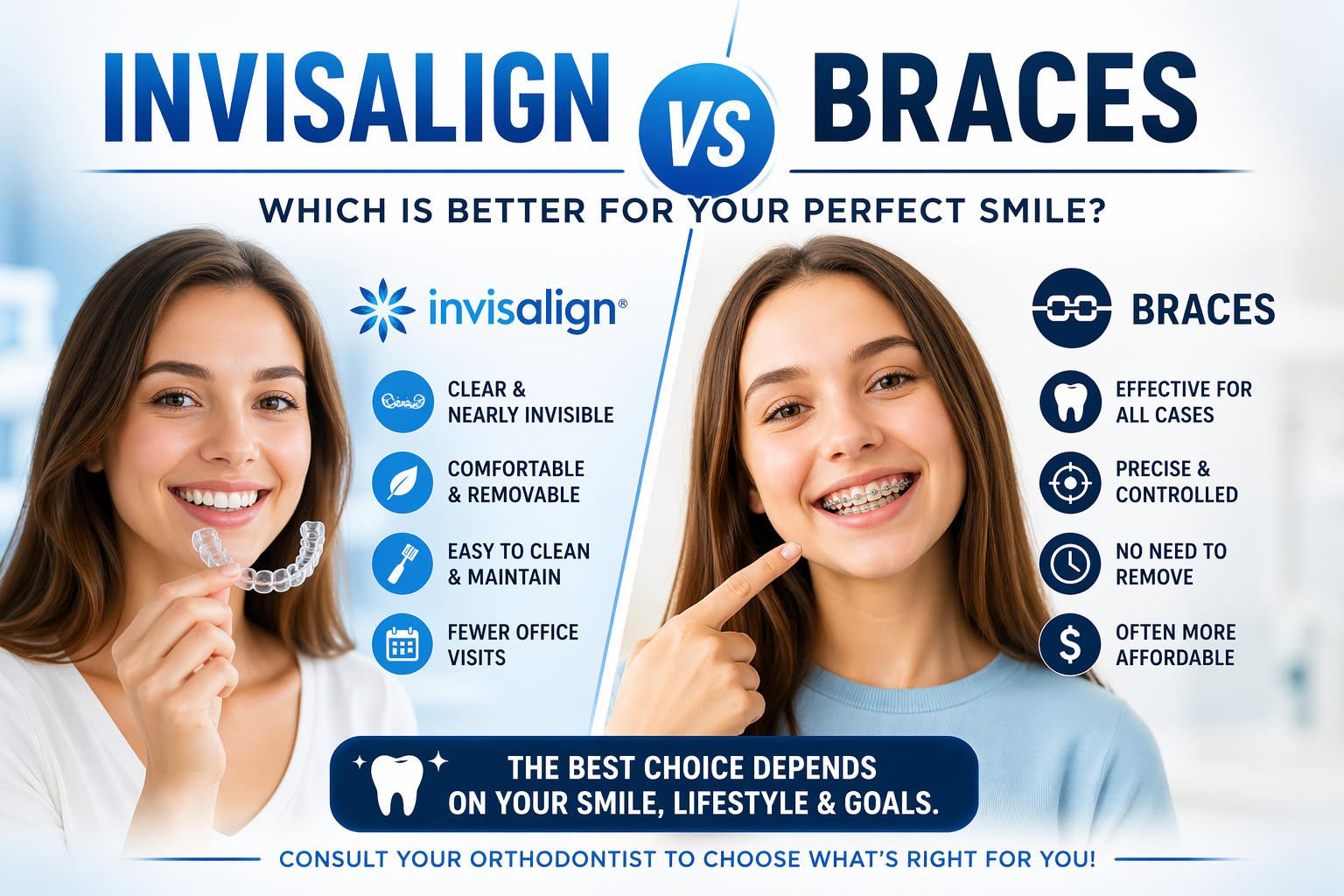
A straight, well-aligned smile not only enhances your appearance but also improves your overall oral health. If you’re considering teeth straightening, you’ve likely come across two popular options: Invisalign aligners and traditional braces.
Both treatments are highly effective, but they differ in appearance, comfort, cost, and lifestyle impact. In this detailed guide, we’ll compare Invisalign vs braces to help you choose the best solution for your smile.
What is Invisalign?
Invisalign is a modern orthodontic treatment that uses clear, removable aligners to gradually straighten teeth. These aligners are custom-made using advanced 3D technology and are nearly invisible when worn.
Patients receive a series of aligners, each designed to shift teeth slightly until the desired position is achieved.
What are Braces?
Traditional braces use metal or ceramic brackets and wires attached to the teeth to move them into alignment over time.
Braces are one of the most reliable and time-tested orthodontic treatments and are suitable for correcting complex dental issues.
Benefits of Invisalign
1. Nearly Invisible
Invisalign aligners are clear, making them an excellent choice for adults and teens who want a discreet treatment.
2. Comfortable Fit
Made from smooth plastic, Invisalign reduces irritation to gums and cheeks.
3. Removable Convenience
You can remove aligners while eating, brushing, or attending special events.
4. Better Oral Hygiene
Since aligners are removable, maintaining oral hygiene is much easier compared to braces.
5. No Food Restrictions
Enjoy all your favorite foods without worrying about damaging brackets or wires.
Benefits of Braces
1. Effective for Complex Cases
Braces can correct severe alignment issues, including major bite problems.
2. Continuous Treatment
Since braces are fixed, they work 24/7 without needing patient compliance.
3. Cost-Effective
Braces are generally more affordable compared to Invisalign.
4. Suitable for All Ages
Braces are effective for children, teenagers, and adults alike.
Treatment Duration
- Invisalign: 6–18 months (depending on case)
- Braces: 12–24 months
Invisalign may be faster for minor corrections, while braces are better for complex treatments.
Comfort & Pain Comparison
- Invisalign causes mild pressure when switching aligners
- Braces may cause discomfort after adjustments
Overall, Invisalign is considered more comfortable due to the absence of metal components.
Lifestyle Impact
Invisalign
- Remove while eating
- No dietary restrictions
- Easy brushing and flossing
Braces
- Avoid sticky, hard, and chewy foods
- Requires careful cleaning
- Regular dental visits for adjustments
Cost Comparison
- Invisalign: Higher cost due to advanced technology
- Braces: More budget-friendly
However, the cost varies depending on the complexity of your case and clinic location.
Which One Should You Choose?
Choose Invisalign if you:
- Want a nearly invisible solution
- Have mild to moderate alignment issues
- Prefer flexibility and comfort
Choose Braces if you:
- Have severe alignment or bite issues
- Want a more affordable option
- Prefer a fixed treatment
Are There Any Risks?
Both treatments are safe when done by experienced dentists. However:
- Poor oral hygiene can lead to cavities
- Not wearing aligners properly may delay Invisalign results
- Broken brackets may extend braces treatment
Regular dental visits are essential for both options.
Aftercare Tips
- Wear retainers after treatment
- Maintain proper oral hygiene
- Visit your dentist regularly
- Avoid habits like nail-biting or chewing hard objects
Conclusion
Both Invisalign and braces are excellent options for achieving a straight, beautiful smile. The right choice depends on your dental condition, lifestyle, and personal preferences.
If you’re looking for a discreet and comfortable option, Invisalign is ideal. However, for complex dental corrections, braces remain the most reliable solution.
Consulting an experienced dentist will help you choose the best treatment for long-lasting results.