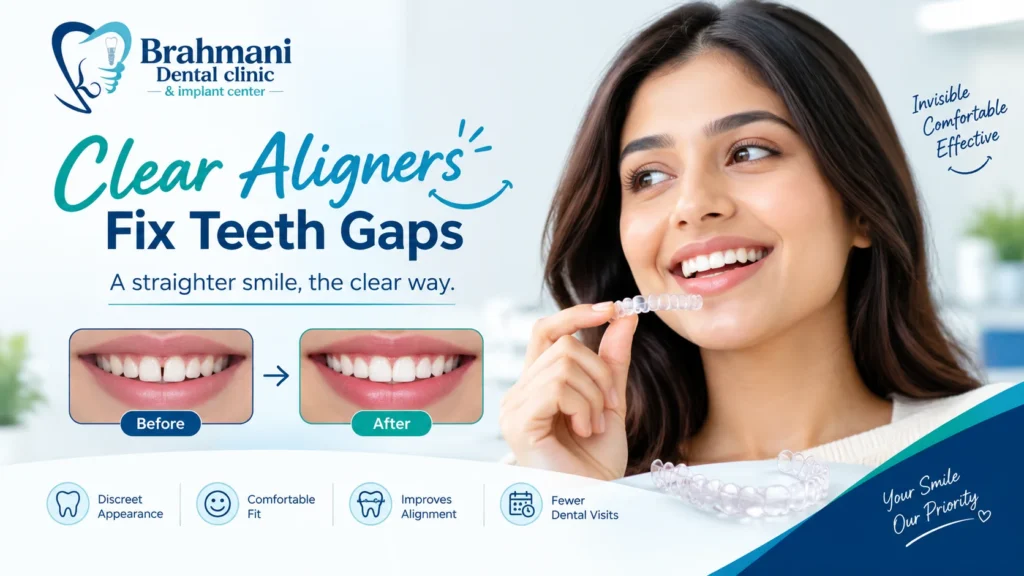
Look at almost any group photo and there’s a decent chance someone is smiling with a small gap between their front teeth. For some people that space is a part of their face they like. For others it’s the first thing they notice in the mirror, and they quietly wonder whether anything can be done about it.
Gaps don’t all come from the same place, and they don’t all behave the same way. So, can clear aligners for teeth gaps actually help? In many suitable cases, they may. Whether they’re right for you depends on how big the space is, why it’s there, where your teeth sit, how your bite works and how healthy your gums are. This guide covers what to expect, including the parts where clear aligners fall short.
What Are Teeth Gaps?
A gap between teeth is simply a visible space where two neighbouring teeth don’t touch. When it shows up between the two upper front teeth, dentists call it a diastema. You can also have spacing between teeth at the sides of the mouth, or a few small spaces scattered along the whole arch.
Gaps between front teeth get noticed the most because they sit right in the middle of your smile. Some people have had theirs since childhood. Others see tooth spacing appear years later.
Here’s something worth saying plainly: not every gap needs fixing. If it isn’t bothering you, isn’t affecting your gums and isn’t causing bite trouble, leaving it alone is a perfectly reasonable choice. If you do want teeth gap treatment, it’s a decision to make with your dentist rather than on your own.
Can Clear Aligners Fix Teeth Gaps?
Often, yes, when the case is right. Clear aligners are a series of thin, removable trays. Each tray differs slightly from the one before it and applies gentle, controlled pressure that slowly nudges teeth towards a planned position. Over time, that movement can bring teeth together and close teeth gaps.
Clear aligners for gaps tend to suit mild to moderate spacing where the bite is otherwise healthy. Aligners for teeth gaps may not be enough by themselves if the space is large or if other problems are involved. In that situation your dentist might suggest a different approach, or a mix of two.
That’s exactly why an examination comes first. Nobody can tell from a selfie whether aligners will work. Your dentist can determine that once they’ve looked at your teeth, gums and bite properly.
How Do Clear Aligners Close Teeth Gaps?
The process is easier to follow when you see it in order:
- Dental examination. Your dentist checks your teeth, gums and general oral health.
- Assessment of teeth and bite. They look at the spacing and at your bite alignment, meaning how your upper and lower teeth meet.
- Treatment planning. A plan maps out how the teeth are expected to move, stage by stage.
- Making your aligners. Your dental aligners are customised to fit your teeth.
- Wearing them as instructed. Consistent wear is what keeps things moving.
- Gradual tooth movement. You switch to a new tray at each stage and your teeth shift a little at a time.
- Monitoring progress. Follow-up visits show whether things are going to plan.
- Retention. Once the active part is done, retainers are often recommended to hold the result.
None of this is instant. Tooth movement is slow, and it’s personal. Two people with similar gaps can move at quite different speeds, depending on age, gum health, the size of the space and how closely instructions are followed.
What Causes Gaps Between Teeth?
There isn’t one single cause, and often it’s a combination. Some of it comes down to how you’re built. Genetics play a big part, since tooth size and jaw size tend to run in families. If your teeth are small compared with your jaw, or a tooth never developed at all, there’s simply extra room. A thick band of tissue between the upper front teeth can also sit in the way and contribute to a diastema.
Other factors build up over time. Pressing the tongue against the front teeth, thumb sucking that carried on in childhood, gum changes that loosen support, or losing a tooth and watching its neighbours drift can all play a role.
That’s general information, not a diagnosis. Only a dental examination can show what’s behind your own spacing, and which gap teeth treatment, if any, would suit you.
Can Clear Aligners Fix All Types of Teeth Gaps?
No. Clear aligners may be suitable for certain kinds of spacing, but they aren’t a universal answer. Here’s how different situations tend to look.
Small and Moderate Gaps
Minor spacing is usually where aligners are considered first, because the teeth may only need to travel a short distance. Moderate gaps can respond well too, though the plan may involve more stages and closer monitoring.
Gaps Between Front Teeth
A gap in the middle of the smile can often be addressed. Even so, the dentist will look at the gum tissue, the bite and how the front teeth meet before suggesting a plan.
Several Spaces at Once
When spacing runs across multiple teeth, movement has to be planned carefully so every tooth ends up stable.
Gaps Mixed With Other Problems
Sometimes the spacing comes packaged with crooked teeth, crowded teeth, an overbite, an underbite or a crossbite. Complex cases like these may need a different teeth gap treatment approach, or aligners combined with other methods.
Clear Aligners for Teeth Gaps vs Traditional Braces
Both are well established forms of teeth straightening, and neither one wins every time. It comes down to your teeth and your life.
Looks and removability. Aligners are less noticeable than metal brackets and wires. People often call them invisible aligners, though they can still be seen up close. Braces are fixed in place, while aligners come out.
Hygiene and eating. Taking aligners out makes brushing and flossing easier and means you can eat normally. With braces, cleaning around the hardware takes more effort and some foods may need to be avoided.
Movement and compliance. Braces work around the clock because they’re attached, and they can manage a wide range of complex movements. Orthodontic aligners suit many spacing cases, but they depend on you wearing them for the hours your dentist recommends.
Daily convenience. Aligners are easy to remove for a meal or a special event. Braces need no daily decisions at all, which some patients prefer.
For severe bite problems or very complicated movements, braces or another approach may be the better route. Your dentist can explain which option fits.
Are Clear Aligners Suitable for Adults With Teeth Gaps?
Plenty of adults look into teeth straightening and other orthodontic treatment for spacing, and clear aligners can be an option for suitable adult patients. Because clear aligners for teeth gaps are less noticeable than metal braces, some adults find them easier to fit around work and social life.
Age alone doesn’t decide anything. What matters more is the health of your gums and supporting bone, the condition of your teeth and the nature of the spacing. Decay or gum disease would normally need attention before teeth alignment work begins.
How Long Does It Take to Close Teeth Gaps With Clear Aligners?
There’s no honest one-size answer. How long clear aligner treatment takes depends on the size and position of the gaps, how far the teeth have to move, your bite and how your teeth respond.
A single small gap may need less time than several spaces, or a gap that comes with other teeth alignment issues. Your dentist can give you an estimate after treatment planning, and it may be adjusted as things progress.
What Happens If You Stop Wearing Clear Aligners?
Removable aligners only work when they’re worn the way your dentist tells you to. If you wear them on and off, tooth movement can slow down and the plan may be delayed or affected.
Stopping altogether is a different story. Teeth can drift back after orthodontic treatment if retention isn’t followed, which is the reason retainers are often recommended once the spaces are closed. Post-treatment retention helps keep properly aligned teeth where they are, so following your dentist’s advice on retainers really is part of the treatment.
Benefits of Clear Aligners for Teeth Gaps
For patients who are suitable, there are some real advantages. Invisible aligners, as they’re often called, are clear and generally less obvious than metal braces, though not truly invisible. As a removable orthodontic appliance, they come out for meals and cleaning, which also keeps brushing and flossing straightforward.
Each plan is built around your own teeth, and the movement happens gradually in small steps. You may feel some pressure when you start a new tray, which is normal as teeth adjust. For many people, the end result is a visible smile improvement without fixed hardware on their teeth.
Are There Any Limitations to Clear Aligners?
Yes, and they’re worth knowing about. Clear aligners for gaps, like other orthodontic aligners, depend heavily on patient compliance, because results rely on wearing them consistently. Some tooth movements are harder to achieve with trays alone, such as correcting significantly rotated teeth. Severe bite problems and certain complex orthodontic cases may call for fixed appliances instead.
Untreated decay or gum problems generally need sorting out first. A professional evaluation is the only reliable way to find out whether any of these limits apply to you.
How to Maintain Oral Hygiene During Clear Aligner Treatment
Good oral hygiene protects your gum health and your overall dental health while your removable aligners are working.
- Brush regularly, ideally before putting the aligners back in.
- Floss every day to clean the gap between teeth that a brush can’t reach.
- Clean your aligners the way your dental team shows you.
- Keep up with regular dental appointments so small problems get caught early.
- Don’t skip cleaning or wear dirty trays, because that can affect your mouth.
Why a Dental Consultation Is Important Before Choosing Clear Aligners
A consultation tells you whether aligners make sense for you and what your overall dental alignment looks like. During a dental examination, your dentist may check:
- Tooth spacing and what’s causing it
- Tooth position and your bite
- Gum health and any tooth decay
- Existing dental restorations
- How your jaws and teeth relate to each other
- Your overall oral health
That assessment is what decides whether clear aligners for teeth gaps are appropriate or whether another route is better. At Brahmani Dental Clinic, an orthodontic consultation is the starting point for understanding your options and putting together a plan that fits your teeth.
Clear Aligners for Teeth Gaps: What Should You Know Before Starting?
Keep this short checklist handy:
- Understand the cause of the gap.
- Get a professional dental examination.
- Follow the wearing instructions for your dental aligners carefully.
- Maintain good oral hygiene.
- Attend all follow-up appointments.
- Follow retention recommendations after treatment.
If you’d like to talk any of this through, the team at Brahmani Dental Clinic can help you understand what to expect.
Frequently Asked Questions
In many suitable cases, yes. Aligners shift teeth gradually towards each other, closing the space as they go. How well that works depends on the size of the gap, what caused it and the health of your teeth and gums, so a dentist needs to look at your mouth first.
Sometimes, though bigger spaces are harder to manage. They can need more stages, closer monitoring or a different orthodontic approach, perhaps alongside aligners. Whether your gap falls within what aligners can realistically handle is something only an examination can answer.
There’s no standard answer. Gap size, how far the teeth must travel, your bite and how consistently you wear the trays all play a part. Your dentist can give a realistic estimate once a treatment plan is made, and that estimate may shift as treatment moves along.
Yes, many adults are suitable candidates. Age on its own doesn’t rule anyone in or out. What matters more is whether your gums and supporting bone are healthy, whether your teeth are sound and what kind of spacing you have. An examination will show where you stand.
Often they can help, including with a diastema. Your dentist will also check the gum tissue, the bite and how your front teeth meet, because those details influence whether aligners alone will do the job or something extra is needed.